Excerpt: You've ordered your electric car. Now you need to charge it. But what charger should you get? How much will installation cost? Which electricity tariff actually saves you money? We asked electricians, charger manufacturers, and real EV owners. Here's what you actually need. And what's a waste of money. (200 characters)
Disclosure: This guide is based on UK electrical regulations and pricing as of May 2026. Installation requirements and costs vary by country and property type. Always obtain multiple quotes from qualified installers. This article contains no sponsored product placements. All recommendations are based on research and owner experience.
The Question Every New EV Owner Asks
You've chosen your electric car. The delivery date is set. Now you're standing in your driveway looking at the wall where a charger will go, and you have questions.
Do you need a 7 kW charger or can you get away with a three-pin plug? How much should installation cost? What's this about smart tariffs and off-peak rates? Do you need a tethered cable or an untethered unit? Should you pay extra for solar integration you might want in three years?
The charger industry has done an impressive job of making a simple device seem complicated. It's a plug on a wall. It delivers electricity to your car. Everything else is optional.
Here's what you actually need. And what you can safely ignore.
Step 1: Can You Charge at Home?
Not everyone can. And the answer determines whether an electric car makes financial sense for you.
You can charge at home if you have:
A driveway, garage, or dedicated off-street parking space
Permission to install a charger (you own the property or have landlord approval)
A suitable electrical supply (most modern homes do, but very old properties may need upgrades)
You probably can't charge at home if you:
Park on the street with no dedicated space
Live in a flat or apartment without allocated parking
Rent a property where the landlord refuses installation permission
Workarounds exist but are imperfect:
Some local authorities install pavement cable channels for terrace houses
Workplace charging can replace home charging if your employer offers it
Public charging networks are expanding, but the cost is typically 3–5 times higher than home charging
If you can't charge at home, be realistic about costs. Public charging will cost more than you expect. The financial case for an EV weakens significantly without home charging. Some owners make it work — but they're making a lifestyle choice, not a cost-saving one.
Step 2: The Three Types of Home Charging
Option 1: Three-Pin Plug (2.3 kW)
The standard UK wall socket. Slow. Very slow.
Charging speed: About 11 km of range per hour
Full charge (60 kWh battery): 26 hours
Installation cost: £0 (you already have sockets)
What you need: The portable charger that came with your car
This is viable only if you drive very little and have no alternative. A 30 km daily commute would take about 3 hours to replenish. If you drive more than 50 km per day, a three-pin plug will struggle to keep up.
Safety note: Standard domestic sockets aren't designed for continuous high-current draw for hours at a time. Old or worn sockets can overheat. If you must use a three-pin plug, have an electrician inspect the socket first. Never use an extension lead.
Verdict: Temporary solution only. Get a proper charger installed as soon as possible.
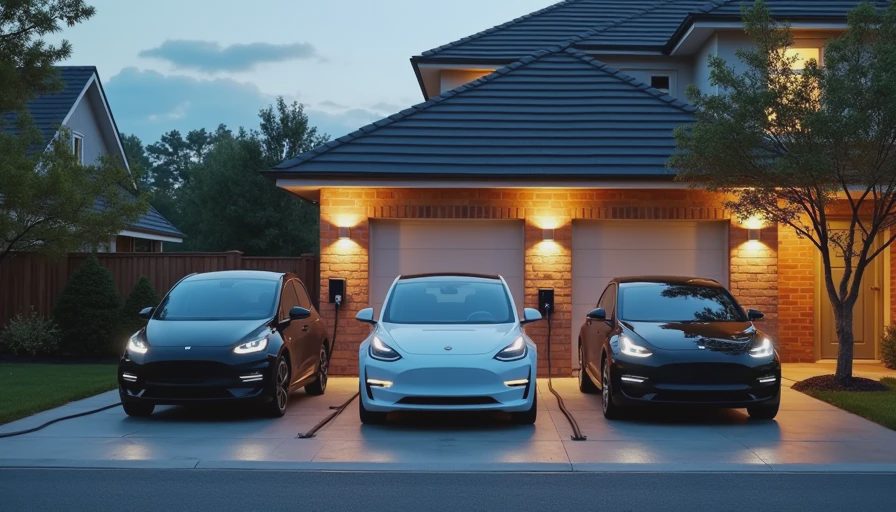
Option 2: Dedicated Home Charger (7 kW)
The standard solution for most EV owners. A wall-mounted unit on a dedicated circuit.
Charging speed: About 40–48 km of range per hour
Full charge (60 kWh battery): 8–9 hours
Installation cost: £450–£1,200 depending on complexity
What you get: Safe, fast, reliable overnight charging
A 7 kW charger will replenish almost any EV from empty to full during an off-peak window. Plug in at 7 pm, wake up to a full battery at 7 am. For the vast majority of drivers, this is all the charging speed you'll ever need.
Tethered vs untethered: A tethered charger has a cable permanently attached. You pull up, grab the cable, plug in. Convenient. An untethered charger is just a socket — you use the cable that came with your car. Slightly neater appearance, slightly more hassle each time you charge. Most owners prefer tethered. The difference isn't life-changing either way.
Verdict: This is what most people need. Get a 7 kW tethered unit from a reputable brand, installed by an OZEV-approved installer.
Option 3: Faster Home Charger (22 kW)
Three-phase power required. Rare in UK homes, more common in continental Europe.
Charging speed: About 120 km of range per hour
Full charge (60 kWh battery): Under 3 hours
Installation cost: £1,500–£3,000 plus potential three-phase supply upgrade (£3,000–£8,000)
This is overkill for almost everyone. Most EVs can't accept 22 kW AC charging anyway — the BYD Atto 3 and Dolphin max out at 7 kW AC, the Seal at 11 kW. A 22 kW charger only makes sense if you have a vehicle that supports it and you need rapid turnaround during the day.
Verdict: Skip this unless you have a specific, proven need. The extra cost will never pay back in convenience.
Step 3: Installation Costs and What Affects Them
A standard installation should cost £450–£800. Factors that increase the price:
Distance from consumer unit to charger location: Cable costs money, and running it through walls, ceilings, or underground adds labour. Every metre beyond 10 metres from your fuse box adds roughly £15–£25.
Consumer unit upgrades: Older fuse boxes may lack RCD protection or spare capacity. A new consumer unit costs £350–£600.
Earthing arrangements: Some older properties need upgraded earthing to meet EV charger regulations. Budget £200–£500 if your electrician flags this.
Ground works: If your charger is on a detached garage or a post away from the house, trenching for the cable adds £300–£800.
Penetration through walls: Standard installation includes drilling one hole through an external wall. Additional penetrations, fireproofing, or complex routes add cost.
Get three quotes. Prices vary significantly between installers. A national company may charge £1,200 for a job a local electrician does for £600. Check reviews. Ask about warranty on the installation work. The charger itself should come with a 3–5 year manufacturer warranty.
Step 4: Choosing an Electricity Tariff
A dedicated EV tariff with off-peak rates is where the real savings live. Standard electricity rates in the UK currently hover around 24p per kWh. A good EV tariff drops that to 7–9p per kWh during off-peak hours.
Typical EV tariff structure:
Off-peak (midnight to 5 am or similar): 7–9p per kWh
Peak (rest of the day): 28–32p per kWh
Standing charge: 45–65p per day
What this means in practice: Charging a 60 kWh battery on a standard tariff costs about £14.40. On an off-peak EV tariff, the same charge costs £4.80. Over 10,000 km of driving, the saving is roughly £700–£900 per year.
The catch: Peak rates on EV tariffs are often slightly higher than standard tariffs. If you use a lot of electricity during the day — running a heat pump, electric oven, tumble dryer — the higher peak rate may partially offset your charging savings. Do the maths on your total household consumption, not just the car.
Smart chargers and tariffs: Some tariffs require a compatible smart charger that communicates with the energy provider. Octopus Intelligent Go, for example, automatically schedules charging when the grid is greenest and cheapest. The charger must be on the provider's approved list. Check compatibility before buying.
Step 5: Solar, Battery Storage, and Future-Proofing
Solar panels and EV charging: Solar panels generate electricity during the day. Most EV charging happens at night. Without a home battery, your solar panels won't directly charge your car unless you're home during daylight hours and plug in manually. The financial case for solar is separate from the financial case for an EV — both are good, but they don't combine as neatly as marketing suggests.
Home battery storage: A home battery — like a Tesla Powerwall or equivalent — stores solar energy for nighttime use, including EV charging. This can work brilliantly, but the upfront cost is significant: £5,000–£9,000 installed. The payback period is typically 8–12 years. It's an investment in energy independence, not a quick money-saver.
Vehicle-to-load and vehicle-to-grid: Some EVs — including several BYD models — support vehicle-to-load, letting you power appliances from the car's battery. Vehicle-to-grid, where the car feeds energy back to the house or grid, is coming but not yet widely available. If this matters to you, check charger compatibility. Most current chargers don't support bidirectional charging.
What to do now: Buy a charger with solar integration capability if you're considering panels within the next three years. The cost premium is modest — perhaps £100–£200. Even if you never use it, you've preserved the option. If solar isn't on your horizon, skip it.
Step 6: The Installation Day
What to expect when the electrician arrives.
The process takes 2–4 hours for a standard installation. They'll mount the charger on your chosen wall, run cable from your consumer unit, install a dedicated RCBO (circuit breaker with earth leakage protection), drill through the wall, connect the charger, test everything, and demonstrate the basic functions.
They should provide: An electrical installation certificate, a building control compliance certificate, and instruction on using the charger and any associated app.
Things to check before they leave: Does the charger start and stop via the app? Does the cable reach the car's charge port comfortably? Are the seals around the wall penetration weatherproof? Is the charger at a comfortable height? Do you understand the scheduling function?
The Simple Recommendation
Your Situation | What You Need | Approximate Cost |
|---|---|---|
Driveway, modern house | 7 kW tethered charger, standard install | £600–£900 |
Driveway, older house | 7 kW tethered charger + consumer unit upgrade | £1,000–£1,500 |
Garage, short cable run | 7 kW tethered charger, easy install | £500–£700 |
No off-street parking | Public charging or workplace solution | N/A |
Considering solar within 3 years | 7 kW tethered charger with solar integration | £700–£1,100 |
Three-phase supply (rare UK) | 11 kW or 22 kW charger if car supports it | £1,500–£3,000 |
For most people, a 7 kW tethered charger from a reputable brand, installed by an OZEV-approved electrician, paired with an off-peak EV electricity tariff, is the sweet spot. Everything beyond that is optimisation. Nice to have. Not necessary.
What Not to Buy
Don't buy the most expensive charger thinking it's better. A £1,200 charger is not twice as good as a £600 charger. The core function — delivering electricity safely — is the same. Premium units add features like LCD screens, energy monitoring, and app ecosystems. These are nice. They're not essential. A mid-range unit from a brand with good warranty support is the sensible choice.
Don't pay for a 22 kW charger unless you know you need it. Most homes don't have three-phase power. Most EVs don't support 22 kW AC charging. You'll pay a premium for capability you can't use.
Don't buy extended warranties on chargers. The standard manufacturer warranty is typically 3 years. Extended warranties are rarely good value for relatively simple electrical equipment.
Don't overthink it. A home charger is a socket on a wall. The industry wants you to believe it's a complex smart home integration decision. It's really not. Buy a reputable unit, get it installed properly, switch to an EV tariff, and get on with enjoying your car. The charger will just work. That's its job.