Disclosure: This article is for informational purposes only and does not constitute financial advice. Incentive programmes and tax rates vary by country and change frequently. Consult a qualified financial advisor before making purchase decisions. All figures reflect UK market conditions as of May 2026.
The Money Question
You've chosen your electric car. Now comes the part nobody enjoys: paying for it.
The sticker price is rarely what you'll actually pay. Financing deals, lease terms, government grants, and tax incentives can shift the real cost by thousands — in either direction. Getting the numbers right matters more than haggling over a few hundred pounds on the purchase price.
This guide walks through your options in plain English. No jargon. No assumptions. Just what you need to know to make a smart financial decision on your Chinese EV.
Option 1: Outright Cash Purchase
The simplest option. You pay the full price. You own the car.
Advantages: No interest charges. No monthly payments. Full ownership from day one. You can sell whenever you want without settling finance. No mileage restrictions.
Disadvantages: Ties up significant capital. EV technology is evolving fast, and depreciation is a real risk. A car bought for £40,000 today might be worth £22,000 in three years. That's your money disappearing, not a finance company's.
Best for: Buyers with available cash who plan to keep the car for five or more years. If you'll hold long enough, depreciation risk diminishes and the interest savings add up.
One important note: Many Chinese EV brands are still establishing their resale value in Western markets. Cash buyers take on more depreciation risk than those who lease. If resale values surprise on the upside, you win. If they don't, the finance company takes the hit on a lease or PCP.
Option 2: Personal Contract Purchase (PCP)
The most common way Brits finance cars. You pay a deposit, make monthly payments for typically 36 or 48 months, then face a choice at the end.
How it works:
You pay a deposit, usually 10–20% of the car's value.
Monthly payments cover the car's predicted depreciation, not its full value.
At the end, you have three options: return the car, pay the balloon payment and keep it, or trade it for a new model and use any equity as deposit.
Example on a BYD Atto 3 at £37,695:
Item | Amount |
|---|---|
Deposit (15%) | £5,654 |
Monthly payment (36 months) | £389 |
Optional final payment (balloon) | £18,200 |
Total paid if you return the car | £19,658 |
Total paid if you keep it | £37,858 |
Advantages: Lower monthly payments than a traditional loan. Flexibility at the end. Protected against depreciation if you return the car.
Disadvantages: You don't own the car unless you pay the balloon. Mileage limits apply — typically 8,000 to 12,000 miles per year. Exceeding them triggers excess mileage charges. You need to maintain the car to the finance company's standards.
Best for: Buyers who like changing cars every three to four years and want predictable costs. The balloon payment protects you from depreciation risk.
PCP and Chinese EVs: Some lenders remain cautious about Chinese brand residual values. This can mean higher monthly payments or larger balloon payments compared to established brands. Shop around. Specialist EV finance brokers often secure better terms than main dealers.
Option 3: Personal Contract Hire (PCH) — Leasing
You're renting the car long-term. You never own it. You hand it back at the end.
How it works:
Pay an initial rental, typically 3, 6, or 9 months' worth of payments upfront.
Fixed monthly payments for the lease term, usually 24 to 48 months.
At the end, you return the car with nothing further to pay, subject to condition and mileage.
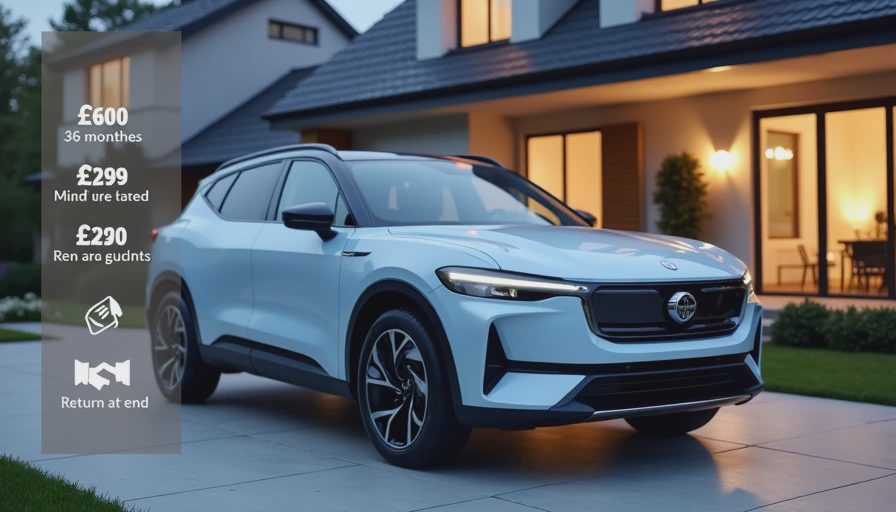
Example on a BYD Dolphin at £30,990:
Item | Amount |
|---|---|
Initial rental (6 months) | £1,794 |
Monthly payment (36 months) | £299 |
Total cost over 3 years | £12,558 |
Advantages: Lowest monthly payments. No depreciation risk. No disposal hassle. Road tax is usually included. Maintenance packages can be added.
Disadvantages: You never own anything. Mileage limits are strict and excess charges are painful. Modifications are usually prohibited. You're committed for the full term — early termination is expensive.
Best for: Buyers who want the lowest monthly cost and like driving a new car every few years with zero ownership responsibilities.
Leasing Chinese EVs: Leasing companies have been slow to price Chinese EVs competitively. Some still apply higher risk premiums. Others, particularly those specialising in EVs, offer strong deals. Get at least three quotes before committing.
Option 4: Hire Purchase (HP)
A traditional loan. You borrow the full amount minus your deposit, pay it back in monthly instalments, and own the car at the end.
Advantages: Straightforward. You own the car once the final payment is made. No mileage limits. No balloon payment decision.
Disadvantages: Higher monthly payments than PCP or PCH. You carry all depreciation risk. Interest rates are typically higher than PCP on new cars.
Best for: Buyers who definitely want to own their car long-term but can't or don't want to pay cash upfront.
Government Incentives: What's Available in 2026
Incentive programmes have shrunk in many countries since the early EV boom, but significant savings remain.
United Kingdom
The Plug-in Car Grant was discontinued for private buyers in 2022. However, other savings apply:
Benefit-in-Kind (BiK) Tax: Company car drivers pay dramatically less tax on EVs. For the 2026–27 tax year, EVs attract just 3% BiK, compared to 30–37% for petrol vehicles. On a BYD Seal used as a company car, a 40% taxpayer would pay approximately £585 per year — versus around £5,850 for an equivalent petrol saloon. Annual saving: over £5,000.
Salary Sacrifice Schemes: Many employers offer EVs through salary sacrifice. You pay for the car from your pre-tax salary, reducing your income tax and National Insurance. On a £40,000 EV, a 40% taxpayer could save £3,000–£4,000 per year compared to a personal lease.
Road Tax (VED): EVs currently pay zero VED. From April 2025, EVs registered after 2017 will pay the standard rate. Used EVs under £40,000 remain in lower bands. Check current rates before budgeting.
Home Charger Grant: The EV chargepoint grant covers up to 75% of installation costs for renters and flat owners. Homeowners in single-unit properties are no longer eligible for the main grant but may qualify for local schemes.
European Union
Incentives vary dramatically by country:
Germany: The environmental bonus was phased out in 2023. Some manufacturers offer their own subsidies. Check brand-specific offers.
France: The ecological bonus offers up to €5,000 for EVs under €47,000. Additional aid for lower-income households.
Netherlands: Zero road tax for EVs until 2025. Company car BiK at 4% for EVs under €30,000.
Norway: Zero VAT on EV purchases under 500,000 NOK. Reduced tolls and ferry fees. Free municipal parking in many cities.
Australia
Federal: No direct EV purchase incentive. The Fringe Benefits Tax exemption for EVs under the luxury car tax threshold is significant for novated leases.
State-level: Victoria and New South Wales offer stamp duty exemptions and registration discounts. Queensland and South Australia have varying rebates. Check your state's current programmes.
The Hidden Savings Nobody Talks About
Beyond the headline finance and incentive numbers, EVs save money in ways that don't appear on the window sticker.
Fuel costs: Home charging on an off-peak tariff costs roughly 2–3 pence per mile. A petrol car at 40 mpg costs about 15–18 pence per mile. Over 10,000 miles, that's £1,300–£1,500 saved annually.
Servicing: No oil changes. No spark plugs. No exhaust system. EV servicing typically costs 30–40% less than equivalent petrol cars.
Congestion charges: London's ULEZ and Congestion Charge zones exempt EVs. Similar schemes exist in cities across Europe. For regular city drivers, this alone can save £2,000+ annually.
Depreciation: The elephant in the room. Chinese EVs are too new for reliable depreciation data. Early MG4 models are holding value reasonably well. BYD residuals are improving as brand awareness grows. If you're worried, lease or PCP — let someone else take the risk.
The Simple Recommendation
If you change cars every three years: Lease or PCP. Lower monthly cost, no depreciation risk, no disposal hassle.
If you keep cars for five or more years: Cash or HP. Long-term ownership makes the interest savings meaningful and depreciation risk diminishes over time.
If you're a company car driver: Salary sacrifice is almost certainly your best option. The tax advantages are substantial.
If you're uncertain about Chinese EV resale values: Lease. The finance company takes the depreciation risk. If residuals surprise on the upside in three years, you can always buy the car at market value and pocket the equity.
Electric cars are already cheaper to run than petrol equivalents. The right finance and incentive strategy makes them cheaper to own as well. Do the maths, shop around, and don't let the sticker price scare you. The real cost is often far lower than it first appears.