I’ll be honest: when I first heard about the Moke electric car, I assumed it was a novelty — a gimmick for rental fleets in touristy coastal towns. But after spending a week with one, driving it on British B-roads and even a rainy motorway stint, I’ve changed my mind. The Moke electric car isn’t a serious commuter or a family hauler, but it doesn’t try to be. What it offers is pure, unfiltered driving joy — if you can live with its quirks. Let’s break down what this battery-powered beach buggy actually delivers.
What Is the Moke Electric Car?
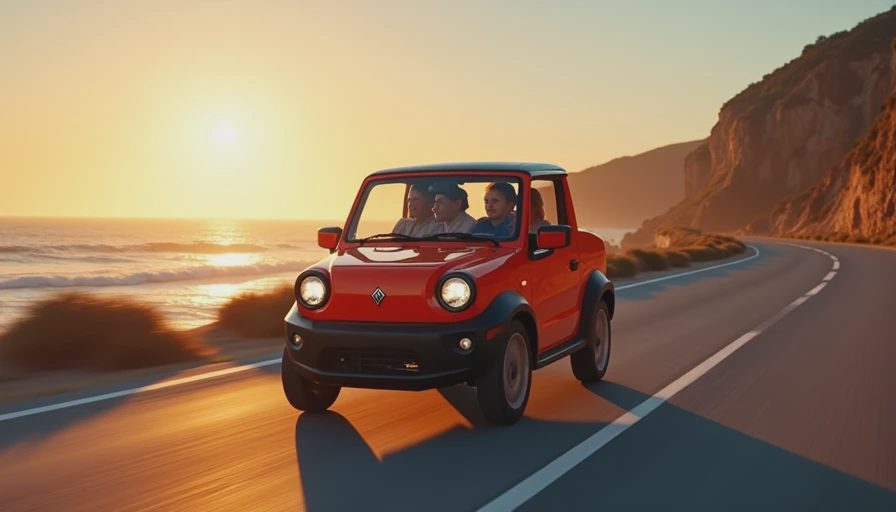
The Moke electric car is a modern, all-electric reinterpretation of the iconic Mini Moke from the 1960s. Made by Moke International (based in Cambridgeshire, UK), it’s a lightweight, open-top, two-seater with a fabric roof and removable side windows. The powertrain is a 20 kW motor (about 27 hp) paired with an 18.8 kWh lithium-ion battery. That’s not a lot by modern EV standards — even a Dacia Spring has more power — but the Moke weighs under 800 kg. Power is sent to the front wheels via a single-speed gearbox. Top speed is 80 km/h (50 mph), so it’s strictly urban and suburban.

Real-World Driving Impressions
Getting into the Moke electric car feels like stepping into a different era — but with a silent heart. The driving position is upright, the steering wheel is thin, and the only thing between you and the elements is optimism. Acceleration from a standstill is surprisingly sprightly; it’ll hit 50 km/h (31 mph) in about 5 seconds, which feels zippy because you’re exposed and low to the ground. The brakes are regenerative but very mild — you won’t get one-pedal driving here. Instead, there’s a gentle drag when you lift off, similar to a manual car coasting in third gear.
On twisty A-roads, the Moke is pure fun. The skinny tires and tall body mean it leans in corners, but in a predictable, playful way. You can hustle it along at its limited top speed, and every roundabout becomes a mini adventure. Noise is… present. The wind is loud above 40 km/h (25 mph), the tires hum, and the suspension thumps over bumps. But somehow it adds to the charm. I found myself smiling more than I have in any modern EV costing ten times as much.
However — and this is important — the Moke electric car is not for motorway use. Driving at 80 km/h on a dual carriageway feels unstable; passing HGVs gives you white knuckles. The lack of sound insulation, the short wheelbase, and the lightweight body make it genuinely uncomfortable. Stick to 60 km/h (37 mph) or below, and you’ll have a blast.
Range and Charging
The official WLTP range for the Moke electric car is 144 km (89 miles). In my real-world mixed driving at 12°C, I averaged about 110 km (68 miles) — a 25% drop, which is typical for small EVs in cold weather. On warmer days with a lighter foot, I saw 130 km (81 miles). That’s enough for a weekend of short trips around town, a beach day, or a backroad run, but not much more.
Charging is via a Type 2 socket (no CCS). Maximum AC charge rate is 6.6 kW, meaning a 10–80% top-up takes about 2 hours and 20 minutes on a 7.4 kW home wallbox. There’s no DC fast charging, so public rapid chargers are useless. You’ll need to plug in overnight or at your destination. For its intended use — daily local driving — that’s fine, but it does limit spontaneity.
Who Should Buy a Moke Electric Car? (And Who Should Skip)
**Buy it if:** you live near the coast or in a sunny, mild climate; you want a second car for short, fun trips; you’re a hotel or resort looking for a fleet vehicle; or you simply want the most smile-inducing EV under £30,000. The Moke electric car starts at £29,995 (about $38,000 USD) — expensive for what it is, but the exclusivity and charm are real.
**Skip it if:** you need a daily driver, commute on motorways, carry more than one passenger regularly, or live somewhere with harsh winters. Also skip if range anxiety bothers you — the Moke won’t ease that.
How It Compares to Alternatives
Comparisons are tricky because the Moke electric car has no direct rival. The closest might be the **Citroën Ami** or **Renault Twizy**, but those are compact quadricycles with even less practicality. The Ami has a top speed of 45 km/h (28 mph) and a range of about 70 km (43 miles) — the Moke is significantly more usable. Another option is a used **Nissan Leaf** or **MG4** for similar money, but they offer proper all-round capability. The Moke is an emotional purchase, not a rational one.
Final Verdict
The Moke electric car is a delightful, impractical, overpriced, and utterly charming thing. It won’t replace your main car, but if you have space and budget for a plaything, it’ll reward you every time you drive it. Just don’t expect it to do school runs or motorway miles. This is a car for sunny weekends, lazy coastal drives, and reminding yourself that driving can be simple, slow, and joyful. I’d love to see a version with a bigger battery and DC charging, but for now, the Moke electric car is what it is — and that’s exactly its appeal.