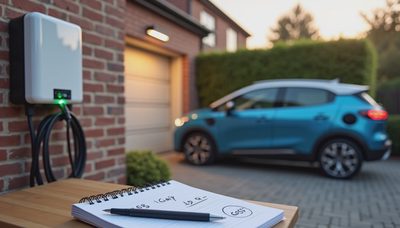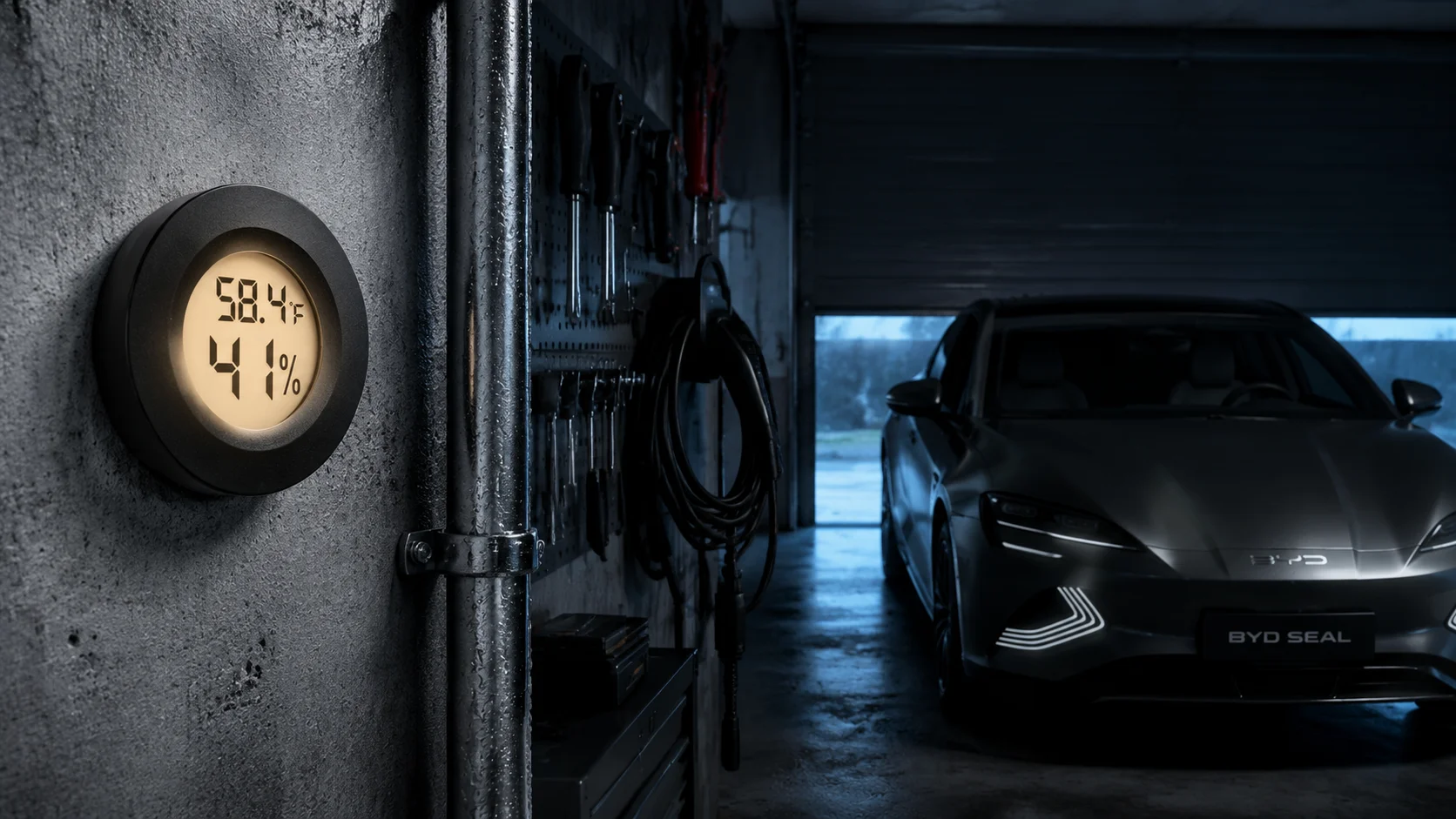
Last January, my BYD Seal kept logging shorter range on cold mornings — nothing dramatic, but consistently off. I'd checked tyre pressures, adjusted the charging schedule, done the usual things. What I hadn't done was look at what was actually happening inside my garage.
When I finally mounted a garage temperature monitor near the charging point, the answer was immediate: 3°C overnight, humidity pushing past 80%, sustained for weeks without my knowing. A compact thermometer hygrometer on the wall told me more about my EV setup in one morning than months of guessing had.
Check Your Garage Climate Monitor →
Why Your Garage Environment Actually Matters for EV Ownership
The Silent Variables Nobody Monitors
Most EV owners track state of charge, charging sessions, and software updates. Almost none track garage conditions — even though ambient temperature directly affects how the battery management system behaves, how charging speed is regulated in cold weather, and how quickly moisture can work on exposed connectors and charging equipment over time.
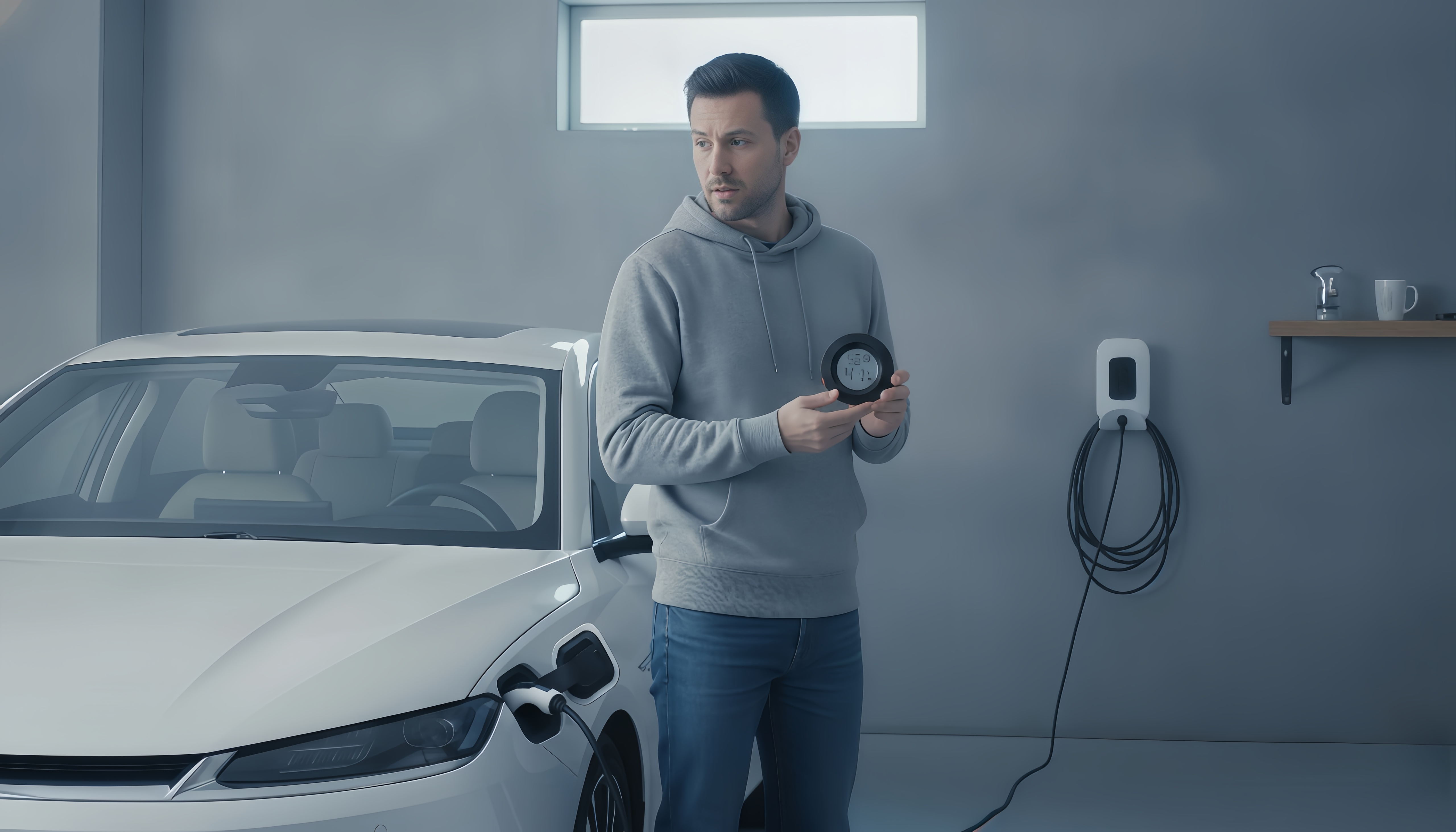
This isn't about catastrophising. A well-sealed modern EV won't fall apart from one damp winter. But EV ownership, done well, is about managing cumulative conditions over years. The same logic that leads you to charge to 80% instead of 100% applies here: small, consistent habits compound into meaningfully better long-term outcomes.
Knowing your garage climate monitor is the first step. Acting on what it tells you is the second.
Temperature and Humidity: The Two Numbers Worth Watching
For everyday EV garage use, these are the figures that matter:
Parameter | Healthy Range | What Happens Outside It |
|---|---|---|
Ambient Temperature | 5°C – 25°C | Below 5°C: charging rate limited; range reduced |
Relative Humidity | 40% – 70% RH | Above 80% sustained: moisture risk to connectors and equipment |
Daily Temp Swing | < 10°C variance | Large swings accelerate condensation on surfaces |
Charging Point Zone | ≥ 10°C | Most EVs throttle charge acceptance below this threshold |
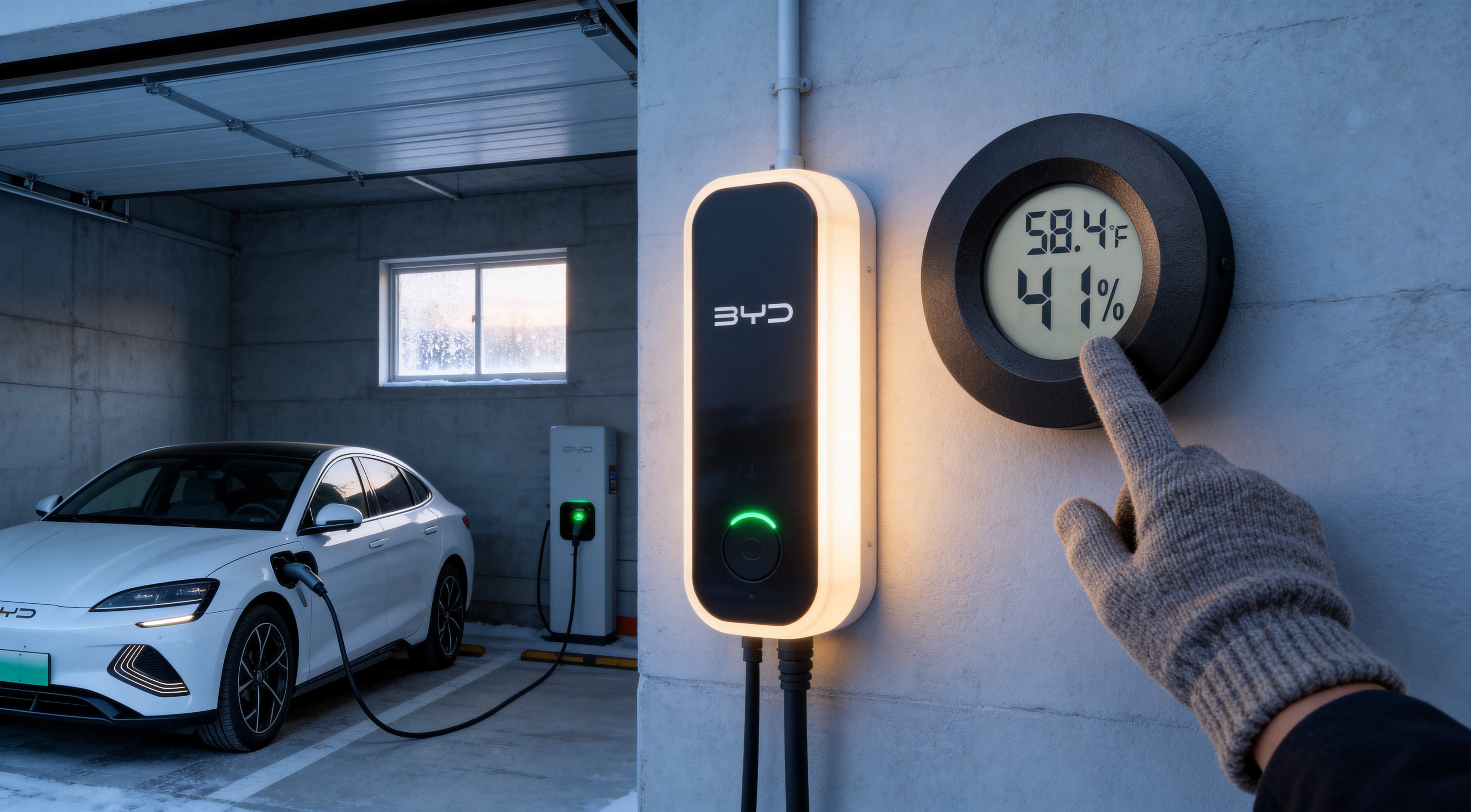
An accurate indoor outdoor humidity monitor placed near your home charging point gives you visibility over all four of these. It takes seconds to glance at. The data it provides is genuinely actionable.
What Separates a Useful Monitor from a Useless One
The market is full of cheap sensor devices that are either wildly inaccurate, painfully slow to update, or dead within a month. I've gone through a few. Here's what the useful ones actually have — and where the unit I settled on earns its place.
Accuracy That's Fit for Purpose
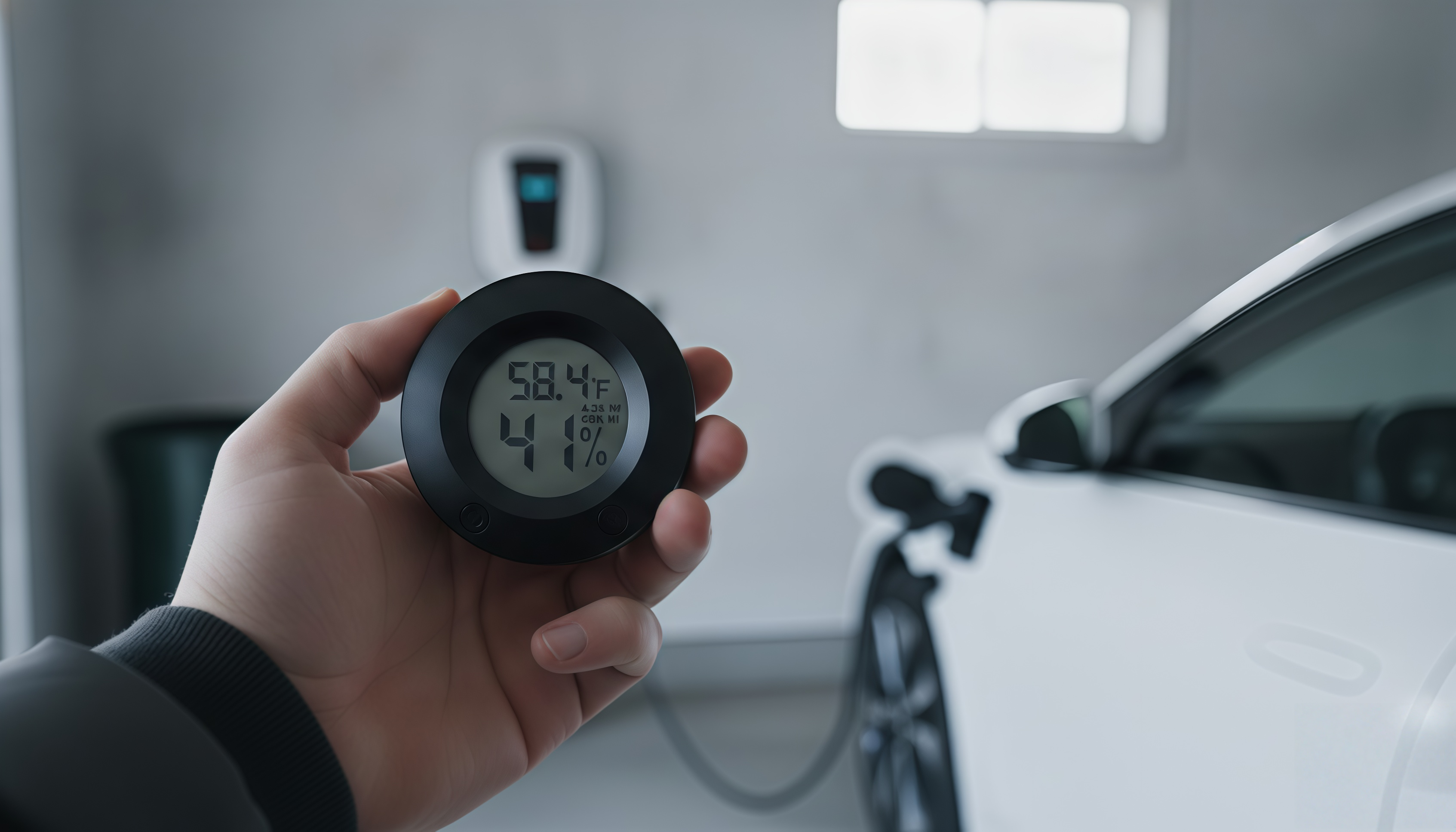
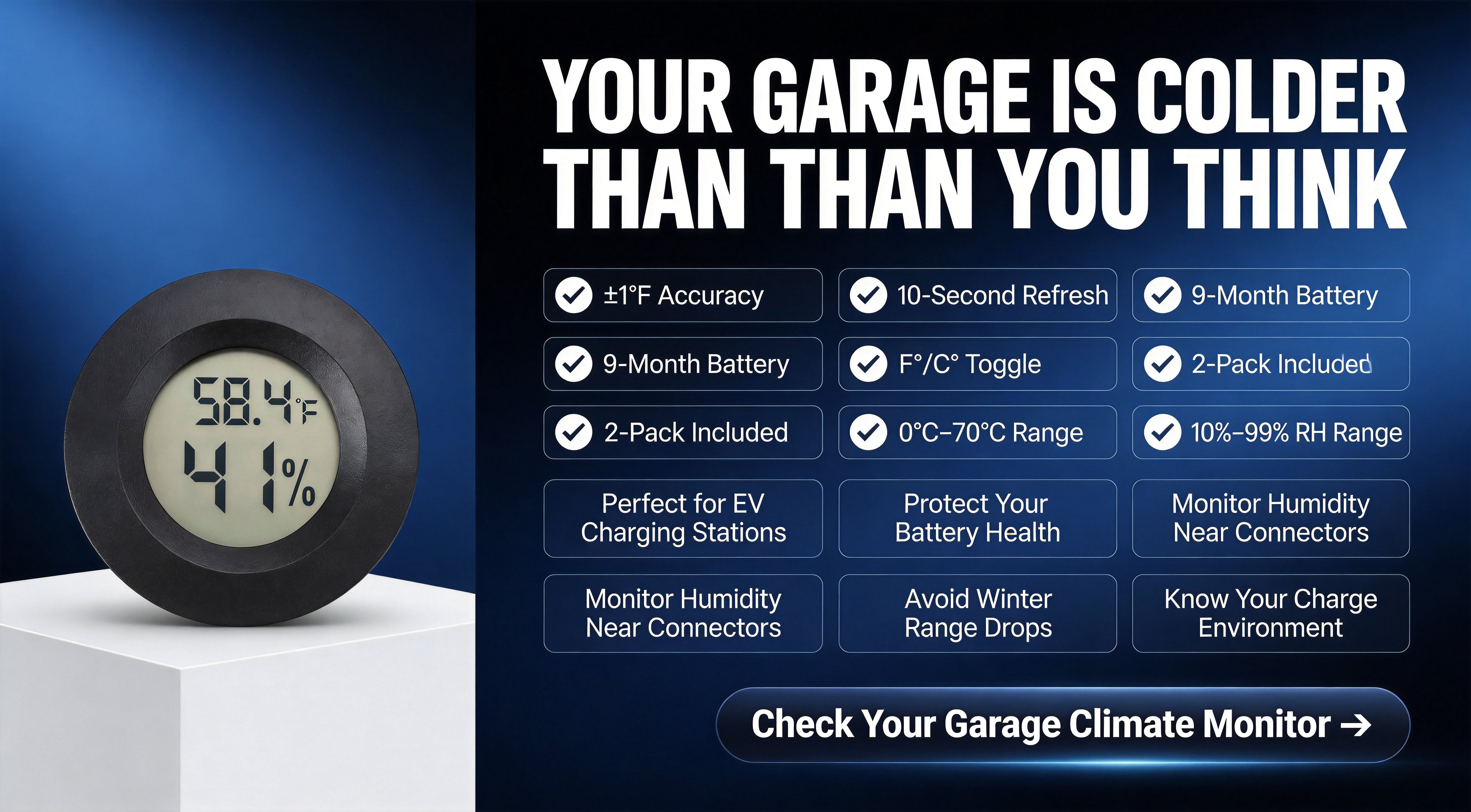
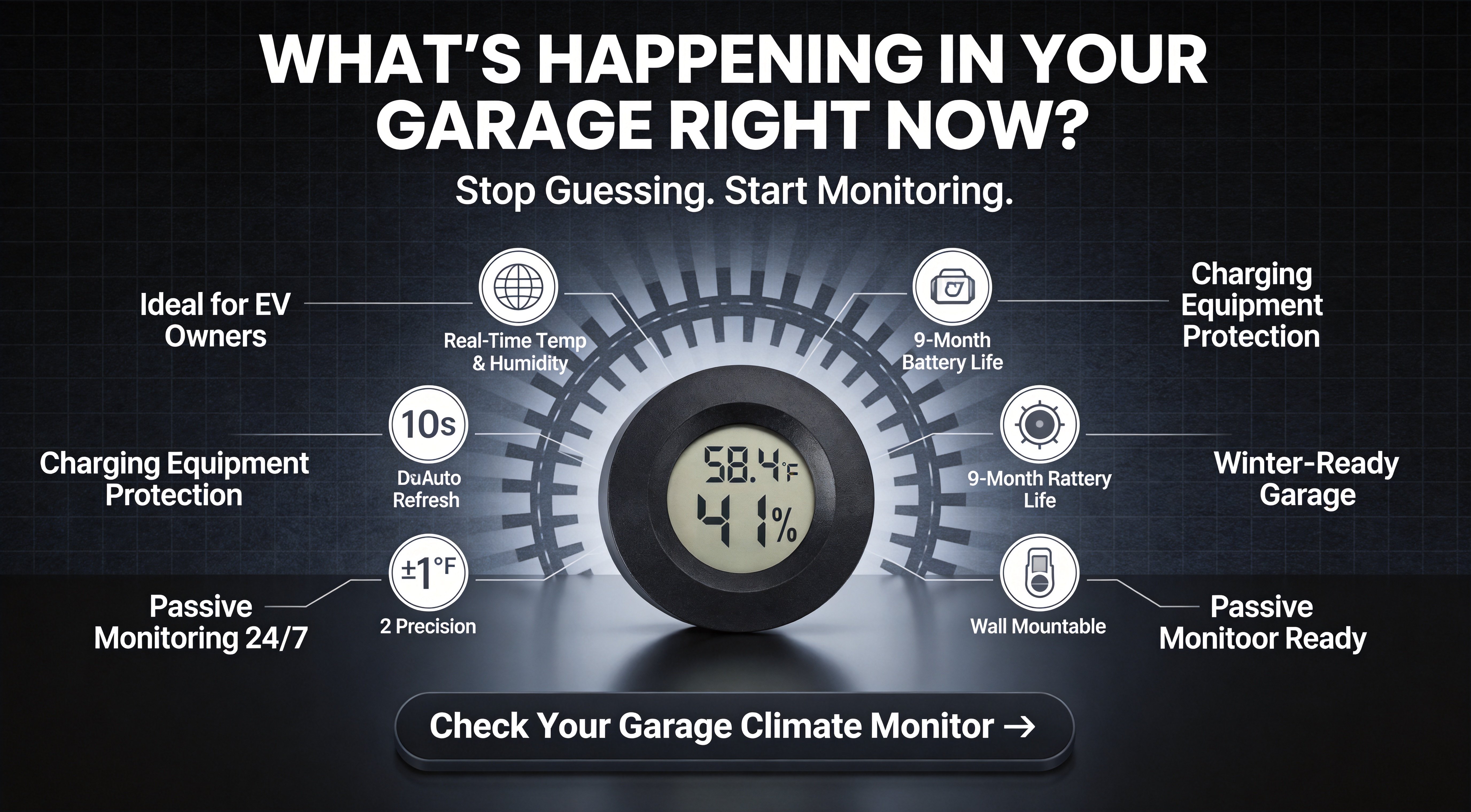
For garage monitoring, you need ±1°F on temperature and ±3% RH on humidity. That's the threshold at which readings are reliable enough to act on. Anything looser and you're just watching a number change without knowing if it's real. The small hygrometer accurate to these specs gives you a genuine read on conditions — not a rough ballpark.
10-Second Refresh Rate: Why It Matters More Than You'd Think
Most budget sensors update every 30 to 60 seconds. That sounds fine until you're tracking a temperature drop after opening the garage door in winter, or watching humidity climb after rain. The 10-second automatic refresh on the unit I use means the display reflects what's actually happening in near real-time. It's a small spec that makes a tangible difference to how useful the device actually is day-to-day.
Nine Months on a Single Battery
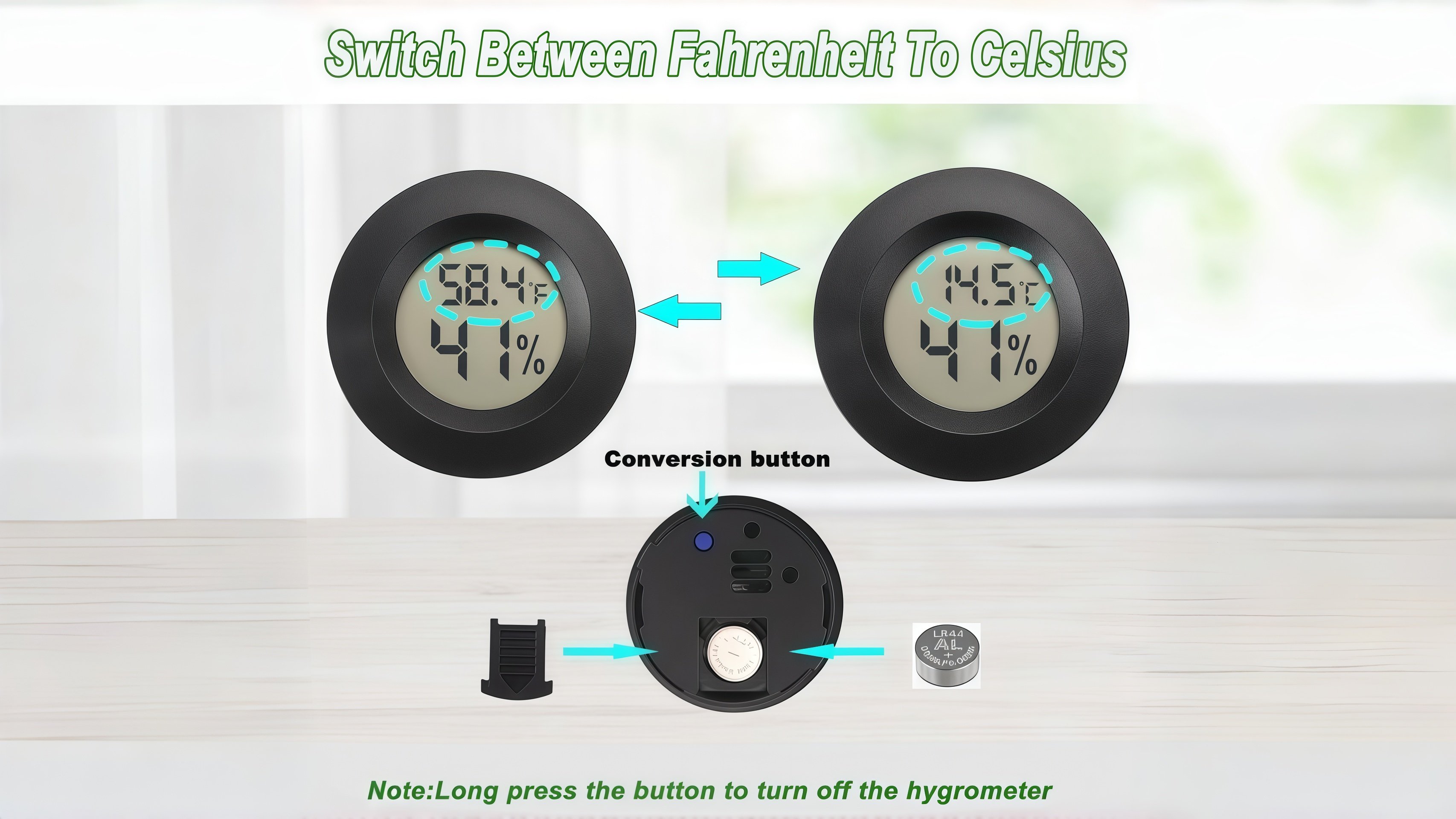
This is the one that genuinely surprised me. Running on a single LR44 button cell, this monitor keeps going for up to nine months on one battery — with a backup cell included in the pack. That's not a throwaway figure. It means fitting it once, forgetting about it, and checking the display when you walk past rather than constantly replacing batteries or recharging a device. For a garage tool that earns its value through consistent passive monitoring, battery longevity matters.
Check Your Garage Climate Monitor →
Fahrenheit/Celsius Thermometer Switching — More Useful Than It Sounds
If you're accustomed to working in Celsius for daily use but your EV's manual quotes battery operating specs in Fahrenheit — or you're sourcing guidance from US-based EV communities — the ability to flip between units on the fly is genuinely convenient. One button. Both scales available instantly. The LCD humidity monitor displays whichever unit you prefer with clear, readable digits.
The 2-Pack Advantage
A single unit gives you one data point. Two gives you a picture. One near the charging point on the wall, one near where the front of the car sits — and you can immediately see whether conditions vary meaningfully across the space. For most UK garages, they do. The 2-pack format works out significantly cheaper per unit than buying singles separately, and for a space where placement matters, having two is the more complete solution.
How I Actually Have Mine Set Up
Placement Logic for EV Garages
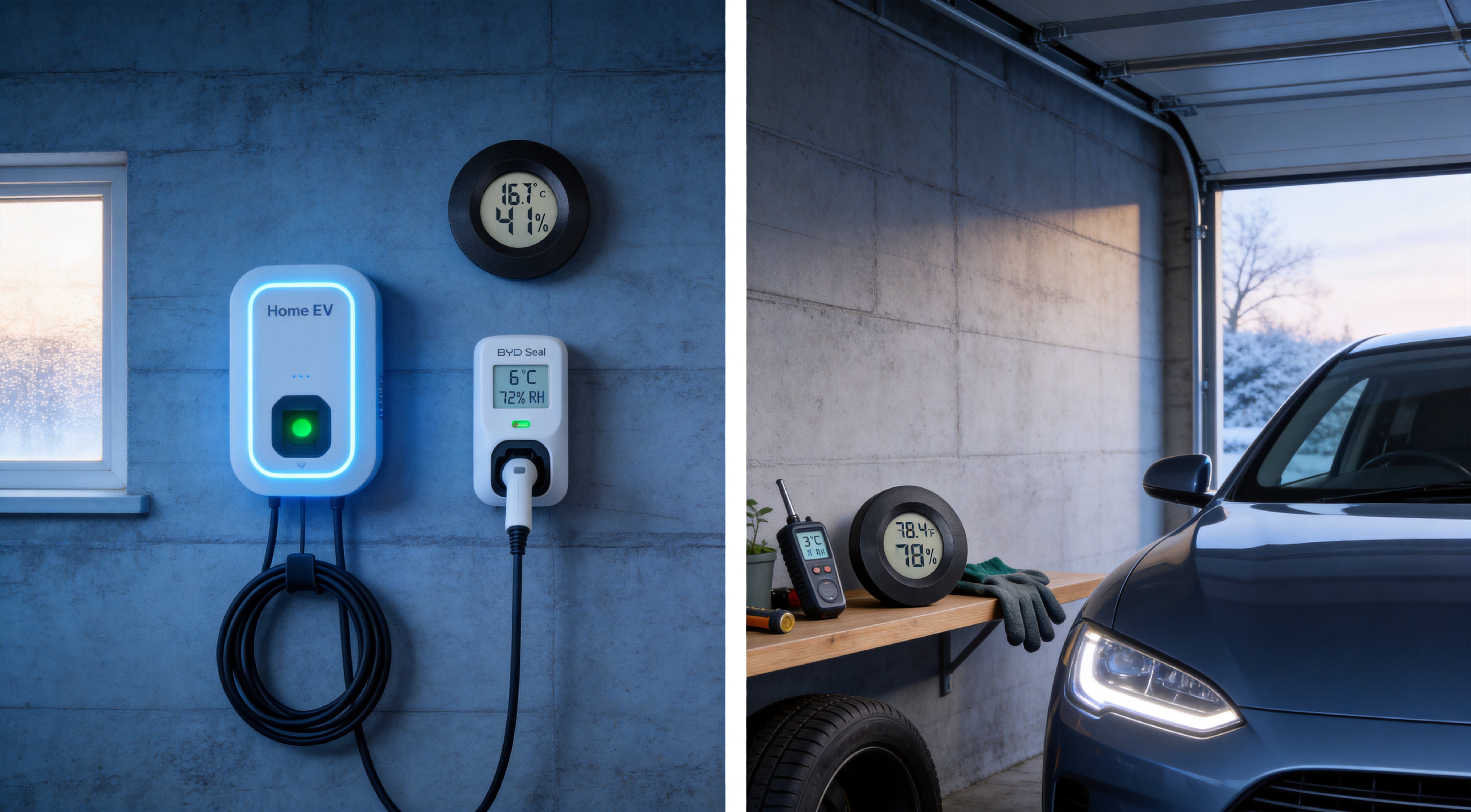
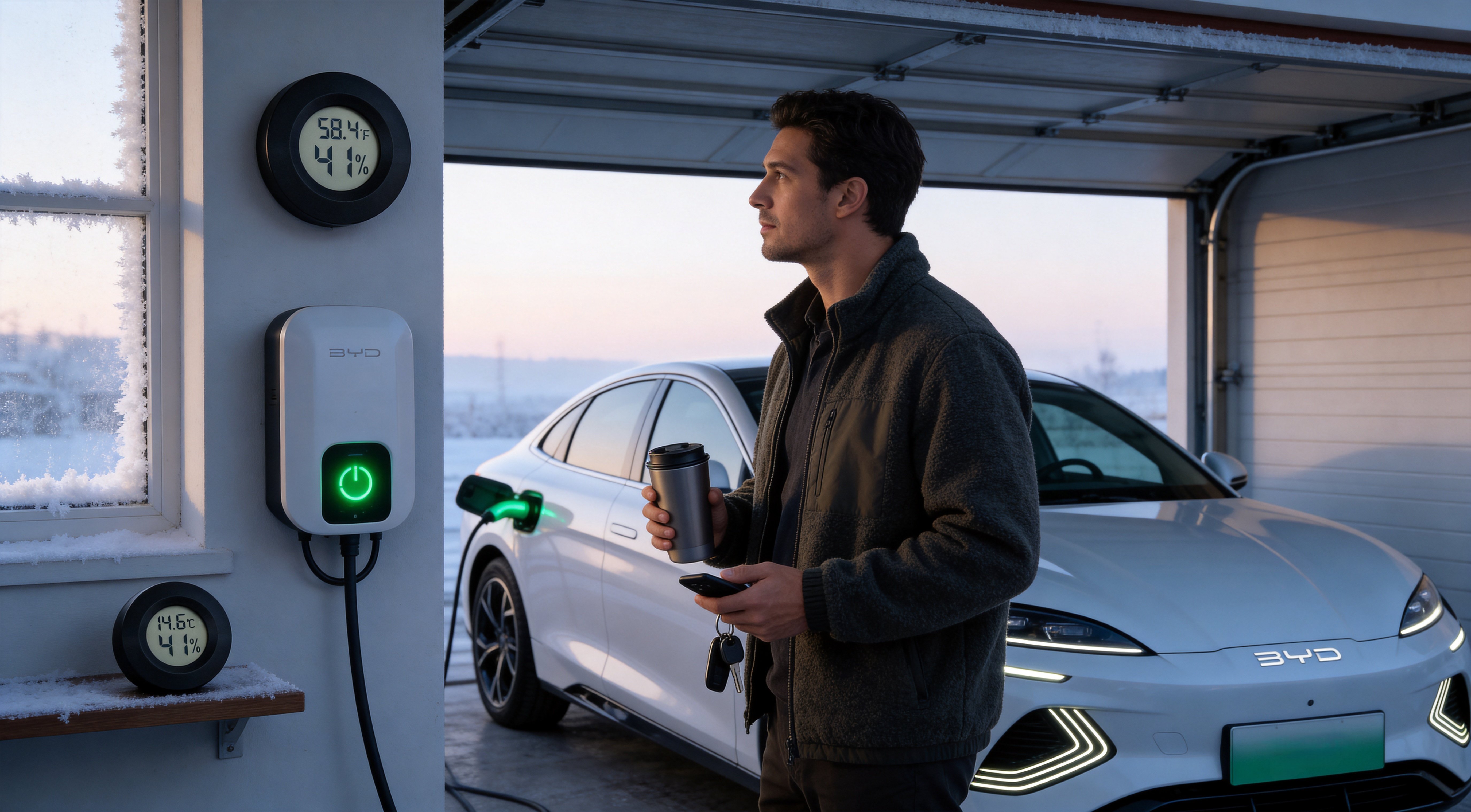
Unit one: Mounted on the wall approximately 30cm above the home charging point. This is the spot I care about most — sustained high humidity near electrical connections is the specific risk worth watching closely.
Unit two: At the far end of the garage, near floor level on the wall opposite the car's boot. Temperature at floor level in an uninsulated garage consistently reads 2–3°C lower than at waist height. Knowing both figures means I can assess whether the battery pack — which sits low in the chassis — is genuinely in a colder microclimate than the rest of the space.
The Routine That Actually Works
I check both units when I arrive home and again before leaving in the morning. It takes four seconds. When I first started, I'd take a mental note. Now I only actively register it when something looks unusual — which, over eight months, has happened twice. Once flagged a humidity spike from a drainage issue I hadn't noticed. Once told me the garage had dropped to 1°C before a long trip, which prompted me to adjust my pre-conditioning settings.
That's the value of passive monitoring. It's not about obsessive watching — it's about having a baseline that makes anomalies visible.
Beyond the Garage: Where Else These Work
The digital humidity meter format these units use isn't EV-specific, and it's worth being straightforward about that. The same device that monitors your charging environment works equally well for:
Home energy storage rooms — battery storage units have similar temperature sensitivity to EV packs
Workshops and utility rooms — tools, paint and wood all have humidity tolerance ranges worth knowing
Greenhouses and garden storage — the wide working range of 0°C to 70°C and 10% to 99% RH covers outdoor seasonal extremes comfortably
Reptile enclosures and aquarium rooms — where precise indoor outdoor humidity monitor readings directly affect animal welfare
If you're buying a two-pack, placing the second unit in a secondary location makes the value case even stronger.

The Honest Case for Adding This to Your Setup
I'm not going to oversell this. A garage hygrometer for electric car owners is not a piece of technology that transforms your EV experience. It won't add range or speed up charging. What it does is close an information gap that most of us didn't know existed.
The running cost is effectively nothing once it's on the wall. The setup time is under two minutes. The data it gives you is immediately legible, passively delivered, and occasionally actually useful — in a way that justifies the category existing at all.
For the price of a decent charging cable accessory, you get 24/7 environmental visibility over the space your car charges and rests in. For anyone invested in long-term EV ownership rather than just getting from A to B, that's a straightforward addition worth making.
Check Your Garage Climate Monitor →
FAQ
Q: Does it have an alarm for extreme temperatures?
A: No, the garage climate monitor does not have an alarm function. It's a basic monitoring device that displays temperature and humidity readings only—it won't alert you if conditions go outside your desired range.
Q: How do I replace the batteries?
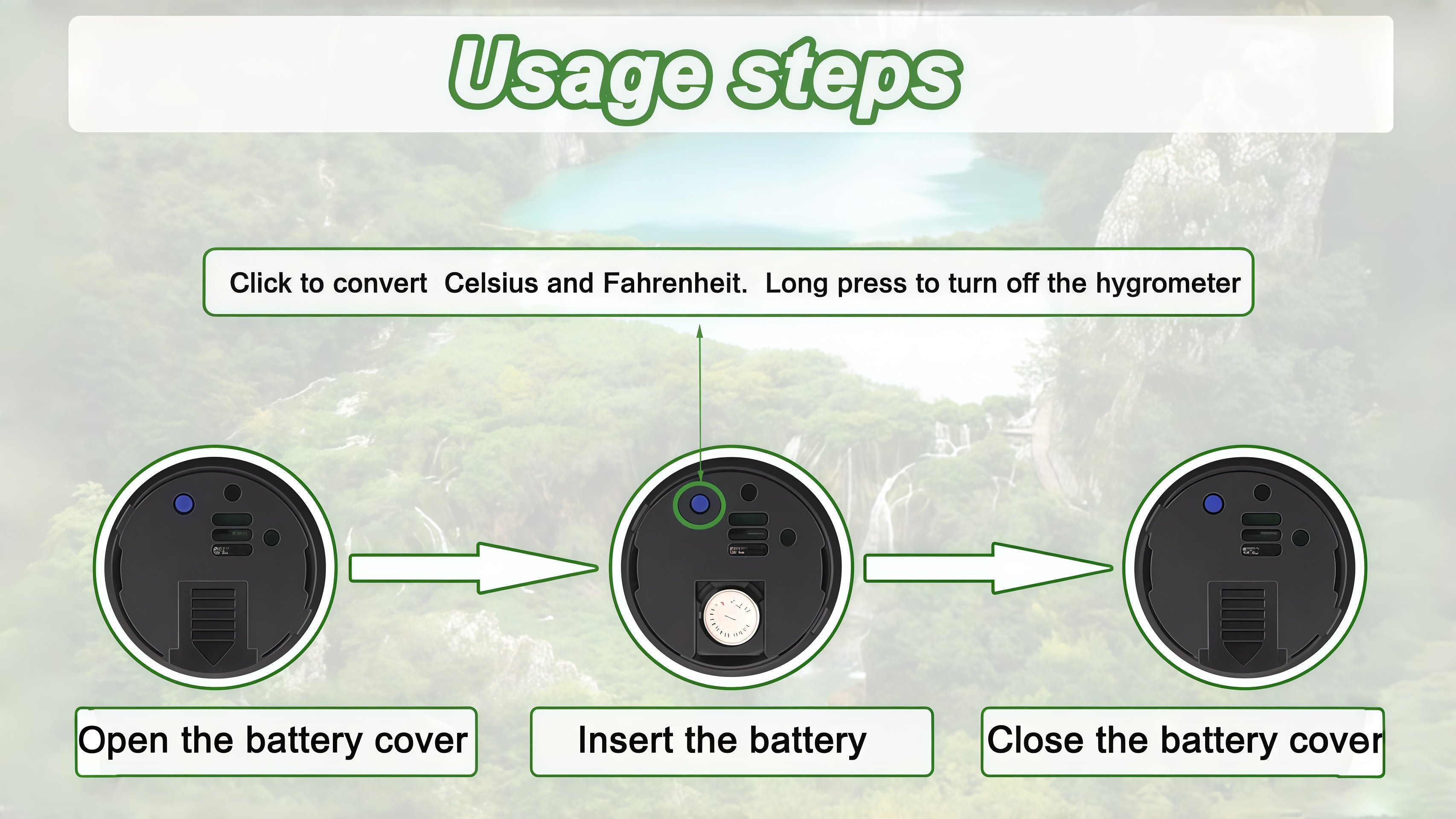
A: The garage climate monitor uses LR44 button cell batteries. To replace them:
1.Locate the battery cover – It's on the back of the device
2.Slide or peel off the cover – One customer suggests cutting the adhesive strip so only the battery cover is stuck, making it easier to open without damaging the unit
3.Replace the LR44 battery – Pop out the old one and insert the new one
4.Close the cover – Slide it back into place
You'll have extra LR44 batteries included in your package to have on hand when replacements are needed.
Q: My garage gets condensation in winter — does that throw off the readings?
A:It can affect response time more than accuracy. If the sensor goes from a cold spot straight into a warmer, damp pocket of air, you might get a thin layer of mist on it for a few minutes before the reading settles. In practice, I just keep mine mounted in one fixed spot rather than moving it around, and I haven't run into this being an issue.
Q: Is the screen readable in a dim garage?
A:The digits are large enough that it's fine under normal lighting. If your garage is genuinely dark — no fixed lighting, just a motion-sensor bulb — it'll be harder to read at night since there's no backlight. Worth knowing going in if your space is on the dimmer side.
Q: Is the 2-pack actually worth it, or just an upsell?
A:For me, yes — garage temperature varies more by location than you'd assume, and relying on a single data point can give you a misleading picture of the space as a whole. That said, if your garage is small or doesn't really have distinct temperature zones, one unit is probably enough. No need to buy two just because the per-unit price looks better.