Disclosure: This article is an educational explainer based on publicly available engineering specifications, manufacturer data, and real-world charging tests. All charging figures reflect independent testing where available. System descriptions are simplified for accessibility.
The Numbers You Keep Seeing
800V. 400V. These numbers are appearing on EV spec sheets with increasing frequency, usually accompanied by bold claims about charging speed. But unless you have an electrical engineering background, the significance isn't obvious.
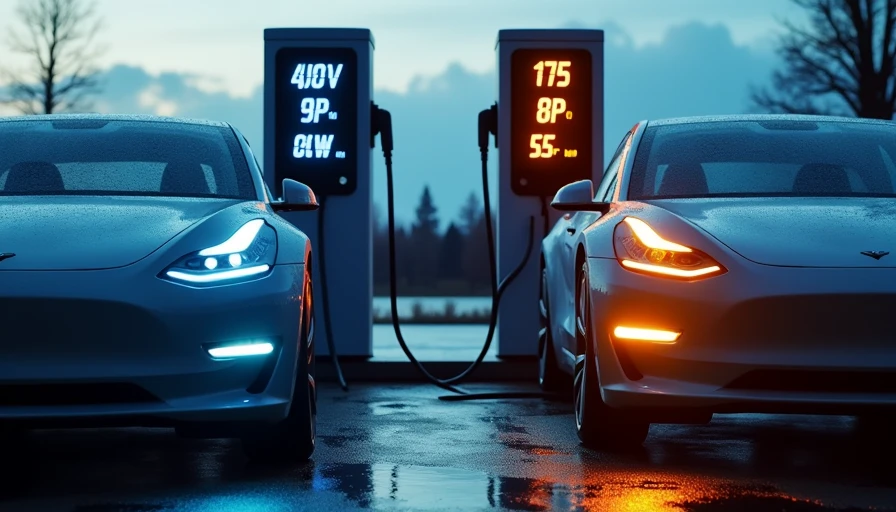
Here's the short version: 800V architecture allows an EV to charge significantly faster than 400V architecture — in theory. In practice, it depends on the charger, the battery, and the thermal management system.
Here's the longer version. It's worth understanding, because the difference between a 400V and 800V EV can mean shaving 10 to 15 minutes off every charging stop on a long journey. Over years of ownership, that adds up to hours of your life back.
Part 1: The Physics — Why Voltage Matters
Charging speed is determined by power, measured in kilowatts. Power equals voltage multiplied by current.
Power (kW) = Voltage (V) × Current (A)
To charge faster, you need to deliver more power. There are two ways to do that: increase the voltage, or increase the current.
Increasing current is problematic. High current generates heat — and heat is the enemy of battery longevity and safety. Managing high current requires thick, heavy, expensive copper cables in the car and in the charger. There are practical limits to how much current you can push through a connector that a human being needs to handle.
Increasing voltage is more elegant. Double the voltage, and you get double the power for the same current. Or the same power for half the current, which means less heat and thinner cables. This is why long-distance electricity transmission lines run at hundreds of thousands of volts — high voltage is the efficient way to move large amounts of electrical power.
A 400V system running at 500 amps delivers 200 kW. An 800V system running at the same 500 amps delivers 400 kW. Same current, same cable thickness, same heat generation — double the charging speed.
This is why 800V architecture matters. It raises the ceiling on how fast an EV can charge without requiring impractical current levels.
Part 2: 400V — The Current Standard
Most electric vehicles on the road today use 400V architecture. This includes every Tesla Model 3 and Model Y, every Volkswagen ID model, the Hyundai Ioniq 5 and Ioniq 6 base models, and most Chinese EVs including all current BYD models.
A well-engineered 400V system can deliver perfectly acceptable charging speeds. The Tesla Model 3 peaks at 250 kW on a Supercharger — that's fast by any standard. Hyundai's 400V E-GMP variants manage around 180 kW. BYD's Seal peaks at 150 kW on its 400V Blade Battery system.
The real-world difference: A 400V EV charging from 10% to 80% typically takes between 27 and 38 minutes depending on the specific vehicle and charger. This is adequate for most users. On a long journey, it's a coffee and a stretch. It's not a hardship.
400V is a mature, proven, cost-effective technology. The components are widely available. The charging infrastructure is built around it. Most DC fast chargers in the ground today are optimised for 400V vehicles. For the majority of EV buyers, 400V is fine.
Part 3: 800V — The Next Generation
A growing number of premium and performance EVs use 800V architecture. Porsche led the way with the Taycan. Hyundai and Kia followed with their E-GMP platform vehicles including the Ioniq 5, Ioniq 6, EV6, and EV9. Chinese brands are now joining the club.
Current Chinese EVs with 800V architecture include:
Brand | Model | Voltage | Peak DC Speed | 10–80% Claimed |
|---|---|---|---|---|
XPeng | G9 | 800V | 300 kW | 15 minutes |
NIO | EL6 (100 kWh) | 800V | 250 kW | 20 minutes |
XPeng | G6 | 800V | 280 kW | 18 minutes |
Li Auto | Mega | 800V | 520 kW | 12 minutes |
The numbers are impressive. XPeng's G9 can add over 200 km of range in 10 minutes on a compatible charger. The Li Auto Mega claims the fastest charging of any production EV — though compatible chargers capable of delivering 520 kW remain rare.
The catch: These peak speeds require compatible 800V chargers. Most public DC fast chargers are 400V units delivering 50–150 kW. An 800V car plugged into a 400V charger will charge at 400V speeds — the car can't force the charger to deliver more voltage than it's capable of.
Part 4: The Charging Curve — Why Peak Power Isn't Everything

Peak charging power is the number that goes in the brochure. The charging curve is what determines your real-world experience.
Every EV battery charges fastest when nearly empty and slows down as it fills up. This is battery physics — as the battery voltage rises, the charger must reduce current to avoid damaging the cells. A typical charging curve looks like a ski slope: steep at the top, flattening out toward the bottom.
What a good 400V curve looks like: The BYD Seal peaks at 150 kW and holds above 100 kW from roughly 10% to 45%. It tapers gradually. 10–80% takes 32 minutes. It's not the fastest, but the curve is flat and predictable.
What a good 800V curve looks like: The XPeng G9 peaks at 300 kW and holds above 200 kW from 10% to 50%. It tapers more aggressively after 60%, but the sheer speed in the first half of the charge means 10–80% takes just 15 minutes on a compatible charger.
The practical difference: On a 400V car, a 20-minute motorway stop adds roughly 180–220 km of range. On an 800V car with a compatible charger, the same 20 minutes adds 300–350 km. That's the difference between a hurried coffee and a leisurely meal.
Part 5: What 800V Means Beyond Charging
Voltage architecture affects more than just how fast the battery fills up.
Efficiency: 800V systems can be slightly more efficient in general driving because lower current means less energy lost as heat in the wiring, motor, and power electronics. The difference is measurable but modest — perhaps 2–5% depending on driving conditions.
Weight: Lower current allows thinner, lighter wiring for the same power delivery. An 800V car's high-voltage cabling can weigh several kilograms less than an equivalent 400V car. Every kilogram saved improves efficiency slightly.
Performance: High-voltage systems can deliver more power to the motors without requiring massive current. This is why 800V architecture often appears in performance-oriented EVs — it enables sustained high power delivery without overheating.
Cost: 800V components are more expensive. The power electronics, battery management system, and charging hardware all require higher-specification parts. This is why 800V remains concentrated in premium vehicles and will take time to filter down to budget models.
Part 6: The Infrastructure Problem
The best 800V car in the world charges at 400V speeds on a 400V charger. And right now, most chargers are 400V.
In the UK, approximately 85% of DC fast chargers are 400V units delivering 150 kW or less. The rollout of 350 kW 800V-compatible chargers is accelerating — major networks including Gridserve, Ionity, and Tesla Superchargers are deploying them — but they remain concentrated on motorway corridors.
What this means for buyers: If you rarely drive long distances, the 800V advantage may be theoretical. Your car will charge overnight on your home charger regardless of its voltage architecture. The extra cost of an 800V vehicle may never pay back in time saved.
If you regularly drive 400 km or more in a day, 800V delivers a genuine quality-of-life improvement — assuming chargers exist on your routes. Check the charger map before paying the premium.
The Chinese 800V Advantage
Chinese manufacturers are adopting 800V architecture faster than their Western counterparts. XPeng has made it a core differentiator. NIO is rolling it out across its lineup. BYD is expected to introduce 800V on its next-generation platform arriving in 2027.
The reason is partly competitive advantage — Chinese brands need features that justify their presence in premium segments — and partly domestic infrastructure. China has deployed over 800,000 DC fast chargers, many of them 800V-capable. The infrastructure gap that limits 800V's usefulness in Europe and North America is far less of an issue in China.
As 800V-capable chargers become more common globally, the advantage of 800V architecture will grow. A car bought today with 800V capability will charge faster in three years than it does now, as the infrastructure catches up.
Which Should You Choose?
Choose 400V if: Budget matters more than charging speed. You charge at home most of the time. You rarely drive more than 300 km in a day. You want the widest choice of vehicles at the best prices. A 400V EV from BYD, MG, or the base Hyundai Ioniq 5 will serve you perfectly well.
Choose 800V if: You do regular long-distance journeys. You value time saved at charging stops. You want future-proofing as charger infrastructure improves. You're considering a premium vehicle where 800V is increasingly standard — and you're willing to pay for it.
The honest truth: For most drivers, most of the time, 400V is fine. The difference between a 27-minute charge and a 15-minute charge matters intensely on a 1,000 km road trip and not at all on a Tuesday commute.
But as 800V technology becomes cheaper and 800V chargers become more common, the gap will narrow. The next generation of mass-market Chinese EVs will likely bring 800V to price points where 400V currently dominates. When that happens, the question won't be "should I pay extra for 800V?" It'll be "why wouldn't I?"
Until then, choose based on your driving patterns, not the spec sheet. The best charging technology is the one that fits your actual life. Not the one that looks fastest in a brochure.